
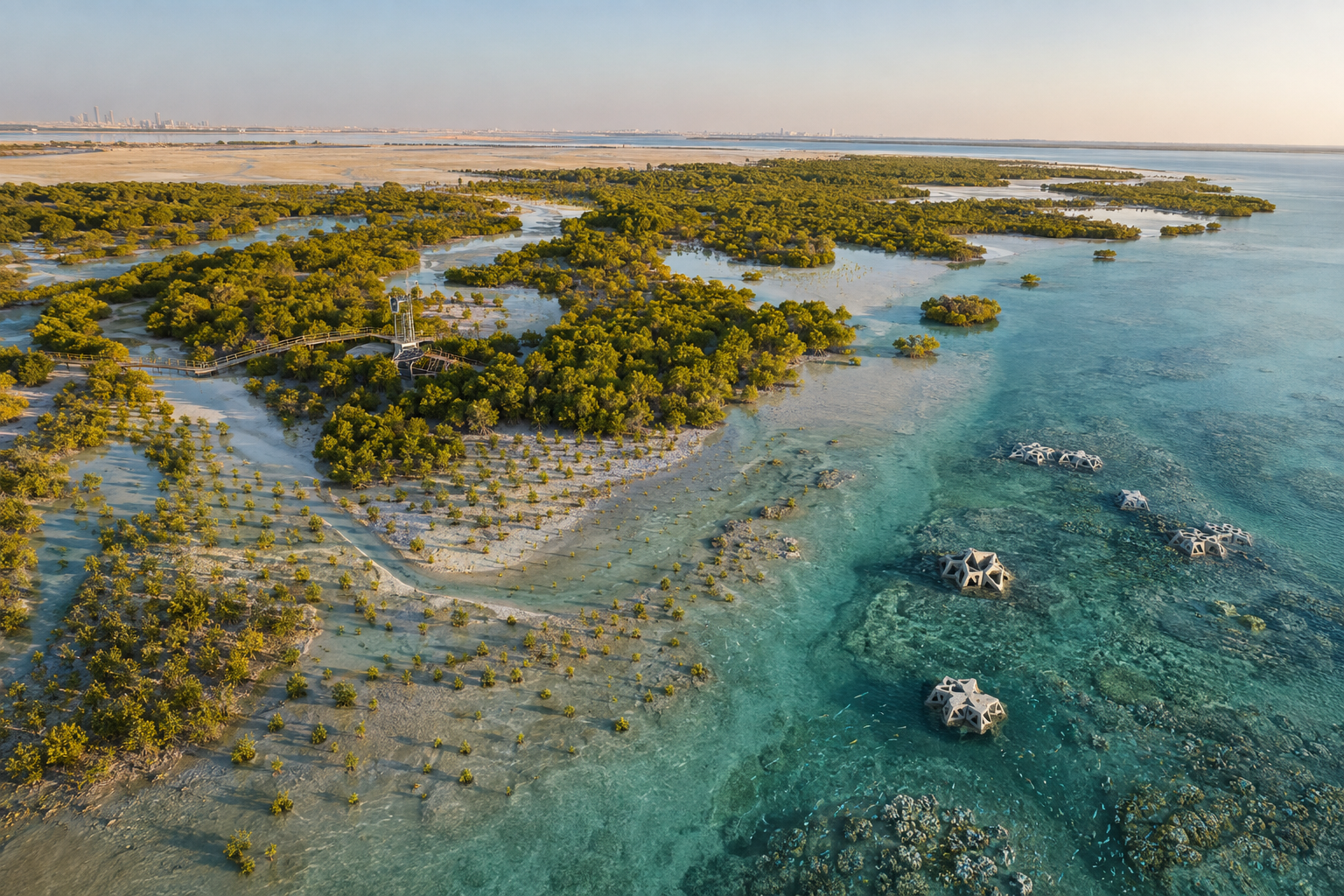
The country is expanding its programs for the restoration of coastlines, coral reefs, and marine ecosystems
The United Arab Emirates has already completed 51% of its national plan to plant 100 million mangrove trees by 2030. In parallel, the country is expanding programs to restore marine ecosystems, develop protected areas, and create artificial reefs.
According to the UAE Ministry of Climate Change and Environment, efforts in this area are gradually shifting from simple conservation of natural resources to the full-scale restoration of damaged ecosystems and increasing their resilience to climate change.
For the UAE, the development of mangrove forests is significant in several ways: they strengthen the coastline, create natural habitats for marine species, and support the country's fish stocks.
Mangrove planting target more than tripled
Initially, the UAE planned to plant 30 million mangrove trees by 2030. The national goal was subsequently increased to 100 million.
Today, according to Hiba Obaid Al Shehhi, Assistant Undersecretary for Biodiversity and Marine Life, 51% of this plan has already been completed.
This scaling up of the program reflects the growing role of mangrove ecosystems in the country's environmental policy.
Mangrove forests serve as a natural breeding ground for fish and a nursery for young marine organisms. At the same time, they help protect the coastline and support the biodiversity of coastal areas.
Marine protected areas to be expanded to 30%
A separate focus of the UAE's environmental strategy is increasing the area of marine protected zones.
Currently, marine and coastal protected areas cover about 12%, with 16 such areas across the country.
By 2030, the share of marine protected areas is planned to increase to 30% in accordance with the UAE National Biodiversity Strategy 2031.
Expanding these zones helps limit pressure on the most sensitive ecosystems and creates conditions for the natural recovery of marine flora and fauna.
The UAE has installed nearly 23,000 artificial reef structures
The marine environment restoration program includes not only mangrove forests but also the creation of artificial habitats.
The ministerial program for deploying artificial reef structures has been in operation since 2016.
By the end of 2025, approximately 22,982 eco-friendly structures had been installed as part of this and related initiatives. They are located in various parts of the country, including Sharjah, Ajman, Umm Al Quwain, Ras Al Khaimah, the Ras Dadna reserve, and the east coast.
Over time, these structures become habitats for fish and other marine organisms, creating additional zones for breeding and the development of young marine life.
Artificial reefs help restore the marine environment
The primary purpose of artificial reef structures is not to decorate the seabed, but to create conditions for the gradual restoration of ecosystems.
Such projects help create additional habitats for marine organisms and support the sustainability of fish stocks.
Fujairah is also implementing projects to create biologically active artificial reefs from natural and recycled materials, designed to restore the marine environment and protect the coastline.
For the UAE, these solutions are part of a broader policy of circular economy, environmental restoration, and sustainable use of natural resources.
Fujairah plans to plant 1.5 million coral colonies
One of the most ambitious projects is the creation of coral gardens in Fujairah.
Over the next five years, the plan is to plant 1.5 million coral colonies across an area of more than 300,000 square meters.
The project is intended not only to facilitate reef restoration but also to create safe zones for local fish species.
According to the Ministry, the coral gardens will cover an area comparable to approximately 60 international football pitches.
Research covers dozens of coral species
The UAE's environmental programs rely not only on direct coral planting but also on scientific research.
The Ministry has conducted experimental cultivation of 24 coral species adapted to the region's climatic and temperature conditions.
Additionally, 210 coral distribution sites have been identified, and more than 55 species of hard coral have been recorded along the country's coastline.
Such research makes it possible to select the most resilient species and plan future reef ecosystem restoration more effectively.
More than 66,000 coral fragments have already been grown
Since 2018, approximately 66,173 coral fragments have been grown as part of previous restoration programs in the UAE.
The work has covered approximately 22,827 square meters of the coastal zone.
Thus, the new program for 1.5 million coral colonies represents the next, significantly larger-scale phase of the experience already gained.
The Ministry is also developing methods to increase coral resilience to rising water temperatures, as marine warming remains one of the main factors in reef degradation.
Environmental projects support the UAE's fish resources
Mangrove forests, coral reefs, and artificial marine structures are directly linked to the sustainability of the fishing industry.
They create zones where juvenile fish receive protection and the opportunity to develop into adulthood.
Particular attention is paid to maintaining a balance between environmental constraints and the interests of professional fishermen.
The Ministry collaborates with fishing associations to discuss breeding seasons for specific species, current fishing regulations, and changes in the state of the marine environment.
Hiba Obaid Al Shehhi called fishermen the "eyes of the environment at sea," as their daily work allows for the prompt detection of changes in ecosystem health.
Aquaculture is becoming part of the food strategy
In parallel with the conservation of natural fish stocks, the UAE is developing its aquaculture sector.
Its production capacity in the country is approximately 2,572 tons, and the number of registered marine aquaculture farms has reached 18.
The development of aquaculture allows for the diversification of food sources while simultaneously reducing pressure on natural fish stocks.
For a country with limited natural resources, this sector is viewed as a component of long-term food security.
Why environmental policy is important for the development of coastal areas
For the real estate market, environmental projects are significant primarily in the context of the quality of the urban and natural environment.
In the UAE, a significant portion of premium residential and tourist real estate is being developed along the coastline.
Therefore, the preservation of marine ecosystems, water quality, beaches, and natural landscapes influences the long-term appeal of such areas for residents, tourists, and property buyers.
This is especially relevant for projects in:
- Abu Dhabi;
- Dubai;
- Ras Al Khaimah;
- Fujairah;
- Sharjah;
- other coastal areas of the UAE.
The natural environment is becoming part of property value
The modern UAE real estate market is gradually shifting toward a model where environmental quality is considered on par with transport, social infrastructure, and service levels.
For buyers of seaside properties, it is not just the size of the property or the view from the window that matters, but also:
- the condition of the coastline;
- beach access;
- the quality of public spaces;
- the number of green areas;
- the environmental standards of projects;
- the preservation of the natural landscape.
Therefore, government programs for marine environmental protection are creating a more sustainable foundation for the development of coastal areas.
What this means for real estate investors
Environmental initiatives do not in themselves guarantee an increase in property prices, but they can enhance the long-term appeal of a specific location.
For an investor, it is particularly important to assess how well a district balances development with the preservation of the natural environment.
In coastal projects, it is worth paying attention to:
- real access to the water;
- the quality of beach infrastructure;
- the density of future development;
- the master developer's environmental policy;
- the development of public spaces;
- preserving green and natural areas.
The higher the quality of the environment, the broader the potential audience of buyers and tenants looking for long-term residency.
The UAE continues its large-scale nature restoration program
Achieving 51% of the target to plant 100 million mangrove trees demonstrates that the UAE's environmental strategy is shifting from isolated initiatives to systemic, national-scale projects.
At the same time, the country is expanding marine protected areas, installing artificial reefs, restoring coral ecosystems, and developing aquaculture.
For the UAE, this is not just an environmental policy, but part of a long-term strategy to improve quality of life, food security, and the resilience of coastal areas.
Against the backdrop of continued urban and real estate market growth, preserving the natural environment is becoming an increasingly significant factor in the country's sustainable development.


.png)

.avif)