
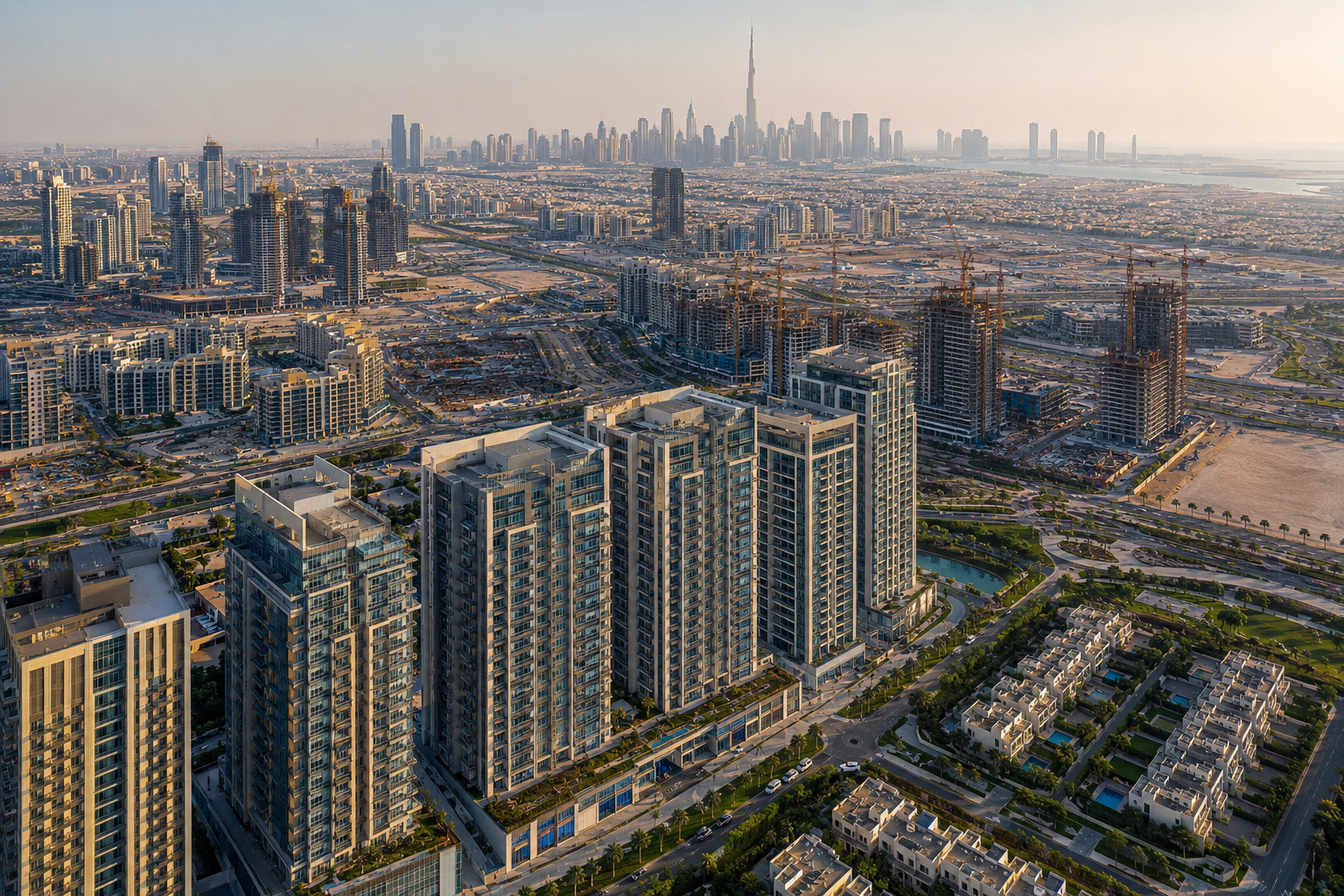
More than 29,000 new investors entered the market in the first quarter of 2026
The Dubai real estate market continues to attract significant volumes of international capital. In the first quarter of 2026, foreign investment in the emirate's real estate reached 148.35 billion dirhams, or approximately 40.4 billion US dollars. This is a 26% increase compared to the same period last year.
During the first three months of the year, the market attracted 48,448 investors, 29,312 of whom were purchasing property in Dubai for the first time. The number of new participants increased by 14% year-on-year.
At the same time, the total value of real estate transactions reached 252 billion dirhams, or approximately 68.6 billion US dollars, an increase of 31%.
This momentum shows that the market is growing not only through repeat purchases by existing investors but also thanks to the expansion of the international buyer base.
Foreign investment volume continues to rise
In the first quarter of 2026, foreign buyers invested 148.35 billion dirhams into Dubai real estate.
The number of foreign investment transactions also grew by 11%, reaching approximately 48,400.
Notably, the value of invested capital grew faster than the number of transactions. This may indicate an increase in the average investment size and more active demand for properties in the mid-range and premium segments.
International capital remains one of the key factors supporting the liquidity of the Dubai real estate market.
Total investment volume reached 173 billion dirhams
The total volume of real estate investment for the quarter amounted to 173 billion dirhams, or approximately 47.1 billion US dollars.
During this period, 57,744 investment transactions were registered.
Year-on-year:
- the value of investments grew by 22%;
- the number of investment transactions increased by 7%.
The gap between the growth rates of transaction value and volume indicates that investors are, on average, deploying more capital into real estate.
For the market, this is an important indicator, as it reflects not only the number of buyers but also the depth of investment demand.
29,312 buyers invested in Dubai real estate for the first time
One of the most notable indicators of the quarter was the number of new market participants.
Between January and March 2026, 29,312 investors purchased property in Dubai for the first time, a 14% increase compared to the previous year.
The rise in new buyers is broadening the emirate's investment base and reducing the market's reliance on a limited group of repeat participants.
These new investors fall into several categories:
- private investors focused on long-term rentals;
- entrepreneurs relocating to the UAE;
- second-home buyers;
- high-net-worth individuals;
- investors diversifying their international assets;
- off-plan property buyers looking for capital appreciation.
This diversity in demand is a key indicator of the market's continued evolution.
The market is moving beyond a standard recovery cycle
The strong performance in the first quarter follows several years of intensive growth in Dubai's real estate market.
However, current trends are increasingly difficult to explain solely as a recovery from previous cycles. The scale of transactions, the influx of new investors, and the rise in foreign capital point to deeper structural changes.
The market is being supported by several concurrent factors:
- Dubai's population growth;
- an influx of high-net-worth residents;
- the establishment of new companies;
- infrastructure expansion;
- the development of long-term residency programs;
- high demand for rentals;
- international capital diversification.
As a result, Dubai real estate is increasingly viewed not just as a regional investment product, but as a viable option for global capital allocation.
Luxury real estate attracted 87.71 billion dirhams
The premium segment also showed high activity.
In the first quarter of 2026, investments in Dubai's luxury real estate increased by 26%, reaching 87.71 billion dirhams, or approximately 23.9 billion US dollars.
The premium and ultra-premium segments continue to attract international buyers due to limited supply in key locations, the quality of new projects, and the demand for residential properties for personal use.
Particularly significant factors in this segment include:
- neighborhood prestige;
- privacy;
- construction quality;
- scenic views;
- proximity to the water;
- developer brand;
- limited supply of comparable properties.
For high-net-worth investors, Dubai real estate can also serve as a tool for international asset diversification.
Why foreign investors choose Dubai
The influx of capital is driven not by a single advantage, but by a combination of the emirate's market and economic characteristics.
When making decisions, investors evaluate:
- economic growth rates;
- opportunities for long-term residency;
- the tax environment;
- infrastructure quality;
- rental demand;
- international transport accessibility;
- business activity;
- real estate market liquidity.
Dubai is no longer just competing for capital with Middle Eastern markets, but with the world's leading real estate investment destinations.
For high-net-worth buyers, the combination of investment potential and the ability to use the property as a personal residence is particularly important.
Investors are becoming more selective about properties
Market growth does not mean that every new project is automatically an attractive investment.
With the increase in supply, buyers are analyzing specific properties and neighborhoods more thoroughly than ever.
This is especially evident in the off-plan segment, where investors compare:
- price per square foot;
- pricing relative to similar projects;
- future supply volume;
- the developer's track record and reputation;
- payment plans;
- handover timelines;
- projected rental demand;
- potential resale liquidity.
This approach matures the market and widens the gap between high-quality projects and properties with weak fundamentals.
Entry price is becoming more important than overall market growth
In a highly active market, it is especially important for investors to evaluate purchase costs relative to specific locations.
Even in a growing neighborhood, a property purchased at an inflated price may underperform compared to real estate with a reasonable entry cost.
Therefore, before purchasing, it is necessary to consider not only the expected growth of the area but also:
- price per square foot;
- current secondary market prices;
- future launches of competing projects;
- potential supply volume by the time of completion;
- the type of end buyer or tenant.
For investors with a multi-year resale horizon, this analysis is particularly critical.
Record activity continues following strong results from previous years
Current figures are being shaped against a high baseline.
According to the data provided, 226,000 real estate transactions were previously recorded in Dubai, totaling 761 billion dirhams, or approximately 207.2 billion US dollars.
The number of transactions increased by 36%, and their total value by 20%.
The results for the first quarter of 2026 show that the market continues to grow even after a period of high activity.
This makes future trends particularly significant: to assess market sustainability, it is necessary to monitor not only new records but also the ability of demand to absorb the pipeline of new supply.
The rental market supports investment demand
A high volume of long-term rentals remains an additional pillar for the real estate market.
In 2025, 1.38 million rental contracts were registered in Dubai, with a total value of 126.4 billion dirhams, or approximately 34.4 billion US dollars.
The number of contracts increased by 6%, and their total value by 17%.
This trend shows that housing demand is supported not only by buyers but also by a large number of tenants.
This is particularly important for investors, as a stable rental market provides a foundation for consistent cash flow and reduces reliance on capital appreciation alone as an investment strategy.
Population growth strengthens fundamental demand
One of the key drivers for the continued development of the real estate sector remains the increase in Dubai's population.
New residents create demand for:
- apartment rentals;
- first-time home purchases;
- family villas and townhouses;
- schools and medical facilities;
- office and retail space;
- everyday service infrastructure.
The more buyers who stay in the city long-term, the higher the fundamental demand from end-users becomes.
This is gradually shifting the market structure, making it less dependent on speculative purchases alone.
What off-plan real estate investors need to know
In the off-plan market, it is especially important to consider the time frame between purchase and handover.
Over a few years, the situation in a neighborhood can change: new projects may emerge, supply may increase, or conversely, new infrastructure may be built that boosts demand.
Before purchasing an off-plan property, you should evaluate:
- the construction completion date;
- the payment plan;
- the developer's track record;
- the area's development prospects;
- the number of nearby projects under construction;
- the potential tenant demographic;
- the possibility of resale before handover;
- the expected volume of completed real estate upon project delivery.
Overall market growth does not compensate for the weak fundamentals of an individual project.
The secondary market is becoming more important as Dubai matures
As a large number of new projects are completed, the significance of secondary real estate will increase.
Completed properties allow buyers to immediately assess:
- actual construction quality;
- the view from the apartment;
- the condition of the building;
- the level of service charges;
- the actual rental rate;
- the neighborhood infrastructure;
- the quality of community management.
For investors, this provides an opportunity to make decisions based on factual data rather than just forecasts.
Completed properties in areas with limited new supply and steady demand from tenants and end-users can remain particularly attractive.
What risks need to be considered
Despite strong performance indicators, investment decisions must account for potential risks.
These include:
- a significant volume of future supply;
- excessively high pricing at the launch of sales;
- construction delays;
- inadequate local infrastructure;
- high competition among similar apartment types;
- rising service charges;
- longer resale timelines.
It is essential for investors to distinguish between the general positive market trend and the economics of a specific deal.
This is why analyzing the property, the developer, and the neighborhood becomes increasingly important as the number of available projects grows.
What will define the next stage of growth
For the continued development of the Dubai real estate market, it is not just new transaction value records that matter.
Several fundamental parameters will be more indicative:
- whether the influx of foreign capital will be sustained;
- whether the number of new investors will continue to grow;
- how successfully the market can absorb new supply;
- whether high demand for long-term rentals will persist;
- how liquid the secondary market remains;
- whether buyers will continue to relocate to Dubai on a permanent basis.
If these indicators maintain their positive momentum, the market will be able to continue its structural development even after several years of rapid growth.
International capital strengthens Dubai's position
AED 148.35 billion in foreign investment in a single quarter confirms the high level of interest from international buyers in the emirate's real estate.
At the same time, the entry of 29,312 new investors into the market shows that the buyer base continues to expand.
For the long-term stability of the market, this may be more important than price records themselves. The more diverse the origin of capital, the goals of buyers, and the segments of demand, the deeper the market becomes.
For investors, the current situation offers a wide range of opportunities but also requires more careful analysis. In a mature market, results depend less on the mere fact of buying property in Dubai and increasingly on the specific location, entry price, project quality, and investment strategy.

.png)
.avif)