
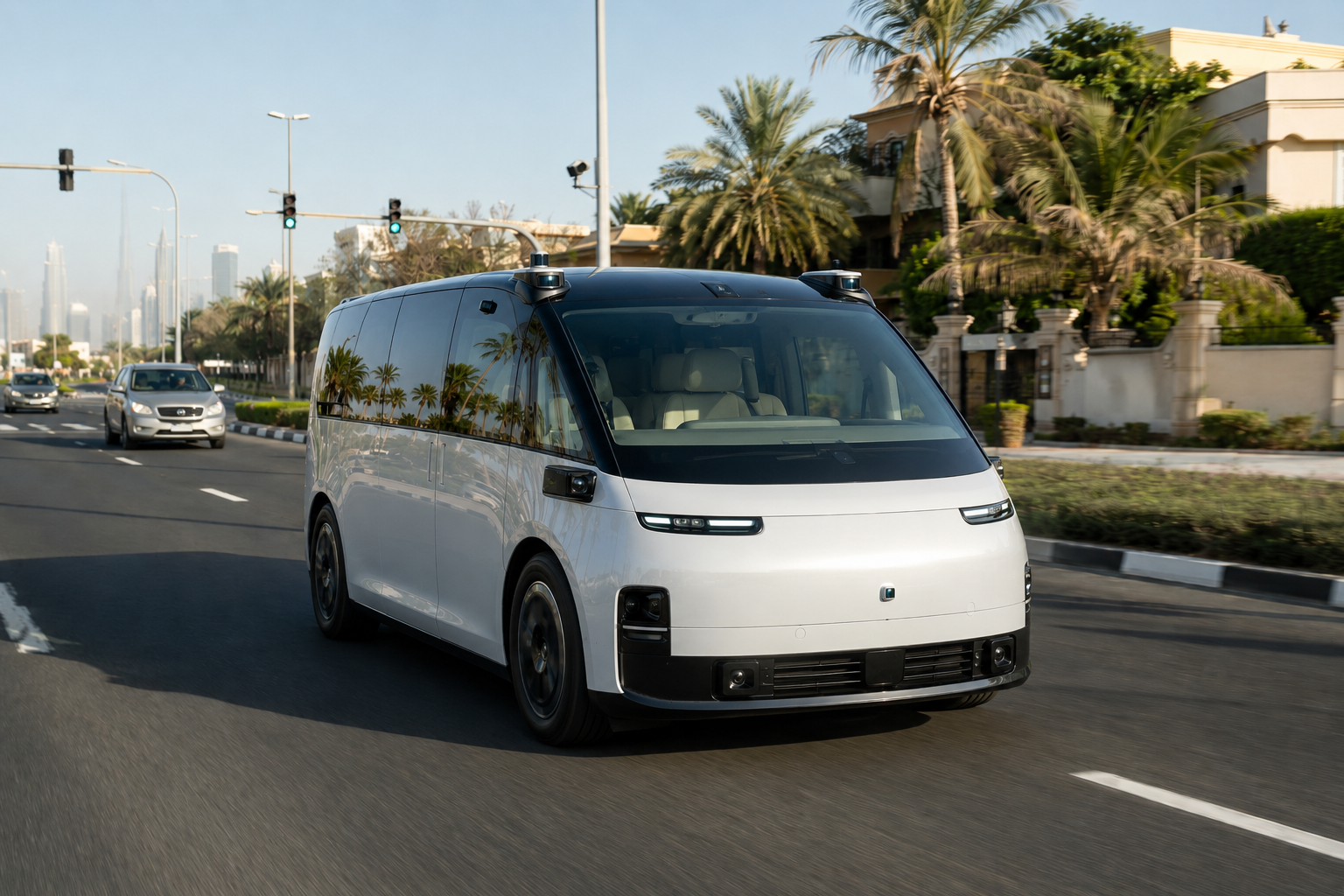
UberX and Uber Comfort passengers may be automatically assigned a fully autonomous vehicle
Dubai has taken another step forward in the development of autonomous public transport. Fully autonomous Apollo Go vehicles from Baidu are now available to book via the Uber app in select areas of the emirate.
Starting August 20, 2026, users selecting UberX or Uber Comfort may be automatically assigned an Apollo Go autonomous vehicle. Additionally, a dedicated Autonomous category is available in the app, which increases the likelihood of being matched with a robotaxi.
In the initial phase, the service is operating in parts of Umm Suqeim and Jumeirah. As the project develops and necessary permits are obtained, the service area is planned to be expanded.
The launch is part of Dubai's broader strategy to implement autonomous transport and develop high-tech urban mobility.
How to book an autonomous taxi in Dubai
Passengers do not need a separate app or special registration if the ride is booked through Uber.
There are two main ways to book:
- select UberX or Uber Comfort — in this case, the system may automatically assign an Apollo Go vehicle;
- select the Autonomous category to book an autonomous vehicle directly, provided the service is available in your chosen area.
At this stage, rides are only available in specific areas of Jumeirah and Umm Suqeim.
The Apollo Go fleet is operated by New Horizon Luxury Transport in partnership with Uber. The project itself is being implemented in collaboration with Dubai's Roads and Transport Authority (RTA).
What vehicles are used
The service uses the sixth-generation Apollo Go RT6, a fully electric robotaxi designed from the ground up for driverless operation.
Unlike a standard car that has been retrofitted for autonomous driving, the RT6 was built specifically as an autonomous vehicle.
The vehicle accommodates up to three passengers and features a spacious rear seating area and electric sliding doors.
It uses over 30 sensors to navigate the urban environment, including LiDAR, cameras, and other environmental recognition systems.
Data is analyzed in real-time while the vehicle is in motion, allowing it to monitor traffic conditions and make decisions instantly.
What happens during the ride
Despite the absence of a driver, the robotaxi operates as part of a full-fledged transport system with remote passenger support.
The service features:
- the ability to quickly contact customer support;
- automatic door opening and closing;
- environmental control systems;
- an autonomous driving suite;
- in-vehicle audio and video recording for safety and support purposes.
According to Uber, customer support can typically reach a passenger in less than a minute.
The vehicle's systems use high-precision digital maps, cameras, LiDAR, and autonomous driving software.
Driverless taxis have been operating in Dubai since March 2026
Commercial operation of autonomous taxis in Dubai officially began on March 30, 2026, in the areas of Umm Suqeim and Jumeirah.
In the first phase, 100 driverless vehicles based on Apollo Go and WeRide technologies were included in the transport network. Apollo Go initially provided the service through its own app in partnership with the Dubai Taxi Company, while WeRide vehicles were available via Uber.
Now, Apollo Go is integrated directly into the Uber platform, expanding the ways to book driverless transport.
Robotaxis have already covered over 4 million kilometers
According to the Dubai Media Office, the autonomous taxi program in Dubai reached a major milestone by August 2026.
Robotaxis have collectively traveled over 4 million kilometers and completed 7,613 passenger trips. The user satisfaction rate was 97%.
At the time of publication, there were 144 autonomous vehicles in the system, 48 of which were in active service, completing about 50 trips daily.
These indicators show that Dubai is gradually shifting from testing technologies to their practical implementation within the city's transport system.
Why Dubai is developing autonomous transport
The development of robotaxis is part of the Dubai Self-Driving Transport Strategy.
One of the emirate's key goals is to have 25% of all transportation trips made by autonomous vehicles by 2030.
To achieve this goal, the RTA is partnering with several international technology companies, including:
- Baidu Apollo Go;
- WeRide;
- Pony.ai;
- Uber.
This model allows Dubai to simultaneously test different autonomous driving technologies and gradually integrate them into the existing transport network.
Apollo Go is already working with the Dubai Taxi Company
Integration with Uber has become the next stage in the development of Apollo Go in the emirate.
Previously, the Dubai Taxi Company and Baidu launched commercial fully driverless rides via the dedicated Apollo Go app. The program planned to start with 50 vehicles and gradually increase the fleet to over 1,000 robotaxis within a few years.
Thus, the same technology is now being developed through multiple channels: the proprietary Apollo Go platform and the international Uber ecosystem.
What the launch means for urban mobility
For Dubai residents, the arrival of robotaxis expands the range of available transportation options.
Autonomous vehicles can complement existing:
- conventional taxis;
- ride-hailing services;
- the metro;
- buses;
- maritime transport;
- other shared mobility formats.
As they scale, robotaxis could be used extensively for short- and medium-distance trips within residential and business districts.
How autonomous transport could impact real estate
For the real estate market, the development of autonomous transport is primarily an infrastructure issue.
Transport accessibility remains one of the key factors when choosing a neighborhood to live or rent in.
If autonomous services eventually expand to more areas, they could:
- simplify commutes to metro stations and business hubs;
- improve mobility within large residential communities;
- reduce residents' reliance on private vehicles;
- increase the convenience of neighborhoods with limited pedestrian access.
However, the mere arrival of robotaxis does not guarantee an increase in property values. For investors, the overall combination of factors remains more important: location, transport, infrastructure, project quality, and actual demand.
Jumeirah and Umm Suqeim have become the first autonomous transport zones
Choosing Jumeirah and Umm Suqeim for the initial launch allows the service to be tested in an established urban environment featuring residential blocks, tourist attractions, public beaches, and heavy traffic.
These districts provide an opportunity to test the technology across a variety of road scenarios.
As data accumulates and autonomous driving systems improve, the service area may gradually expand.
Dubai is shaping a new transport ecosystem
The launch of Apollo Go via Uber shows that autonomous vehicles are gradually moving from an experimental format to a standard urban service.
In February 2026, Sheikh Hamdan bin Mohammed bin Rashid Al Maktoum officially launched the operation of fully autonomous RT6 vehicles, marking the project's transition to a public commercial phase.
Today, passengers can already book a driverless car through the familiar Uber app, and further expansion of the service will be part of Dubai's long-term commitment to developing smart and autonomous mobility.
For the city, this is not just a technological experiment, but part of a broader strategy aimed at improving the convenience of the transport system, developing digital services, and creating infrastructure for future population growth.

.png)


.avif)