
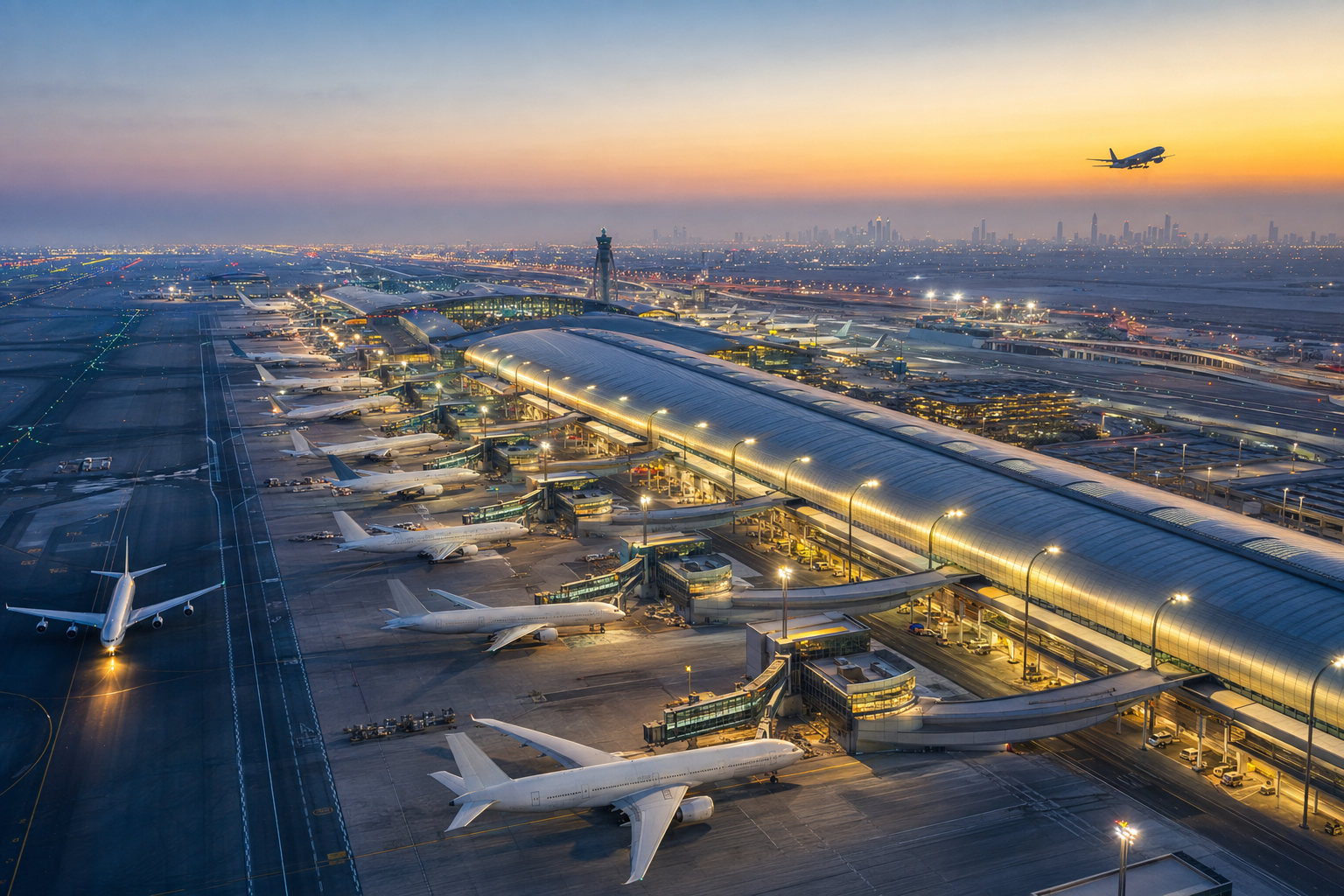
The country's aviation sector continues to grow against a backdrop of infrastructure investment
Airports in the United Arab Emirates have set a new record for passenger traffic. In 2025, the country's airports handled 156.8 million passenger movements, a 6.1% increase over the previous year.
For comparison, UAE airports handled 147.8 million passenger movements in 2024. This represents an annual increase of approximately 9 million.
Flight activity also increased simultaneously. The number of aircraft takeoffs and landings reached 855,300, up 6.8% from 801,000 operations the year before.
Data from the Federal Competitiveness and Statistics Centre confirms the UAE's continued strengthening as one of the world's major aviation hubs.
Transit passengers make up the largest share of traffic
The statistics account for arrivals, departures, and transit through the country's airports.
In 2025:
- the number of arriving passengers reached 44.2 million, an increase of 6.1%;
- the number of departing passengers grew by 3% to 43 million;
- transit traffic increased by 8% to reach 64.3 million people.
Transit remained the largest segment of passenger traffic, accounting for 44.3% of the total volume.
The high proportion of connecting passengers reflects the UAE's strategic location between Europe, Asia, and Africa, as well as the significant role of national airports in international air travel.
Aviation investments support continued growth
Abdulla bin Touq Al Marri, UAE Minister of Economy and Chairman of the General Civil Aviation Authority, attributed the industry's results to consistent investment in airport, aviation, and logistics infrastructure.
The UAE continues to develop:
- airport capacity;
- international route networks;
- air navigation infrastructure;
- freight logistics;
- training national specialists;
- international cooperation in the aviation sector.
The strategy also provides for further improving the quality of passenger and cargo transport services.
Dubai handled over 104 million passenger movements
Dubai has maintained its status as the country's largest aviation hub.
In 2025, the emirate's airports handled 104.5 million passenger movements, compared to 100.9 million the previous year, representing a growth of 3.5%.
The breakdown of Dubai's traffic was as follows:
- 30.2 million arrivals;
- 29.5 million departures;
- 44.7 million transit movements.
As a result, Dubai accounted for approximately 66.6% of the UAE's total passenger traffic.
Transit accounted for approximately 42.8% of all passenger movements through the emirate's airports.
Abu Dhabi increased passenger traffic by 10.7%
Abu Dhabi's airports showed significantly higher growth rates.
The emirate's passenger traffic grew from 30.8 million to 34.2 million movements, an increase of 10.7% over the year.
Of these:
- 8.3 million were arrivals;
- 7.9 million were departures;
- 17.9 million were transit.
Abu Dhabi accounted for about 21.8% of the country's total passenger traffic, with more than half of the emirate's traffic—52.3%—consisting of transit passengers.
Together, Dubai and Abu Dhabi accounted for nearly 88.5% of all passenger traffic through UAE airports.
Sharjah maintains its position as the country's third-largest aviation hub.
Sharjah International Airport also recorded double-digit growth.
The airport handled 16.9 million passengers over the year, an increase of 10.7% compared to 2024.
The traffic breakdown was as follows:
- approximately 5 million arrivals;
- approximately 5 million departures;
- 6.8 million transit passengers.
In terms of total passenger volume, Sharjah retained its third-place ranking among the emirates.
The rise in aviation activity supports the development of both the tourism and business sectors in the emirate, making the region more accessible to international travelers and businesses alike.
Ras Al Khaimah surpasses the 1 million passenger milestone.
Ras Al Khaimah demonstrated one of the most significant growth trends.
Passenger traffic at the local airport surged by 56.8%, rising from 639,300 in 2024 to over 1 million in 2025.
Federal statistics recorded:
- 513,900 arrivals;
- 451,400 departures;
- 37,500 transit passengers.
This growth is driven by the expansion of the emirate's tourism infrastructure and the launch of new hotel and development projects.
For Ras Al Khaimah, increased transport accessibility is a key factor in the continued development of its tourism and real estate markets.
Fujairah recorded the highest percentage growth.
Fujairah showed the highest relative growth rate among the emirates listed.
Passenger traffic increased by 170%, from 61,100 to 164,600 movements.
Of the total:
- 90,200 were arriving passengers;
- 70,600 were departing passengers;
- 3,700 were in transit.
Despite the small absolute volumes compared to Dubai or Abu Dhabi, this trend reflects the gradual development of aviation connectivity in the northern and eastern emirates.
The number of flights grew faster than passenger traffic
In 2025, the country's airports handled 855,300 aircraft movements.
This represents a 6.8% increase, while passenger traffic grew by 6.1%.
The number of arriving aircraft reached 414,300, an increase of 7.3%. The number of departing aircraft grew at a similar rate to 414,100.
The remainder of operations consisted of domestic flights between UAE airports.
However, the published data does not include information on average aircraft load factors, so it is not possible to directly assess flight occupancy trends based on these figures alone.
UAE ranked first in the world for air transport quality
Further confirmation of the industry's development is the country's position in the international IMD World Competitiveness Yearbook 2026.
The UAE ranked first in the world for air transport quality.
This high ranking is attributed to several advantages:
- modern airport infrastructure;
- high operational standards;
- an extensive international route network;
- passenger service quality;
- aviation industry efficiency.
This enhances the country's appeal to tourists, international companies, and investors alike.
Why passenger traffic growth is vital to the UAE economy
Aviation plays a fundamental role in the country's economy.
Rising passenger numbers support several sectors at once:
- tourism;
- hospitality;
- retail;
- logistics;
- food and beverage;
- transportation;
- business services;
- commercial and residential real estate.
The more people arrive in the UAE for work, leisure, business, or relocation, the greater the demand for hotels, offices, retail spaces, and housing.
Therefore, aviation industry metrics serve as a key indirect indicator of the country's overall economic activity.
How airport development impacts the real estate market
For the real estate market, the combination of passenger traffic growth and major investments in airport infrastructure is particularly significant.
In Dubai, the ongoing development of Al Maktoum International Airport is creating a new economic cluster in the southern part of the emirate and driving interest in Dubai South, Emaar South, Expo City Dubai, and Jebel Ali.
In Abu Dhabi, the increase in air traffic strengthens the emirate's position as an international business and tourism hub.
In Ras Al Khaimah, the expansion of the route network is happening in tandem with the development of resort infrastructure, which is increasing the international accessibility of the emirate's real estate market.
For an investor, what matters is not just the proximity of a property to the airport, but the growth in jobs, tourism, business, and population that comes with aviation development.
Which real estate segments may see increased demand
The development of the aviation industry can support several market sectors.
Residential real estate
The growing number of employees in aviation, logistics, tourism, and service companies is creating additional demand for long-term apartment rentals and family housing.
Hotels and serviced apartments
The increase in international passenger traffic supports hotel occupancy rates and the development of new accommodation facilities.
Office real estate
The expansion of aviation and logistics clusters encourages the emergence of new companies and demand for workspace.
Retail space
The growth in the number of tourists and residents increases demand for restaurants, shops, and various services.
Industrial and logistics real estate
The development of airports and cargo transportation creates a need for warehouses, distribution centers, and industrial infrastructure.
What these indicators mean for investors
A record passenger volume of 156.8 million movements confirms the UAE's high level of international connectivity and the ongoing growth of its transport infrastructure.
When choosing real estate, it makes sense for investors to consider:
- the development of nearby airports;
- the introduction of new transport routes;
- the growth of business clusters;
- job creation;
- tourism dynamics;
- regional development plans;
- the volume of future real estate supply.
Aviation growth does not in itself guarantee an increase in the value of an individual property, but it can create additional long-term demand drivers in well-located areas.
Aviation infrastructure strengthens the UAE's investment appeal
Record figures for 2025 demonstrate the steady development of the country's aviation sector.
Dubai has maintained its lead in passenger traffic, Abu Dhabi and Sharjah have shown double-digit growth rates, and Ras Al Khaimah and Fujairah have significantly increased their figures from a lower base.
At the same time, the UAE continues to invest in airports, airlines, logistics, and international connectivity as part of the long-term We the UAE 2031 strategy.
For the real estate market, such infrastructure is of strategic importance: it supports tourism, business, the migration of professionals, and population growth — factors that shape demand for residential and commercial property in the long term.



.avif)