
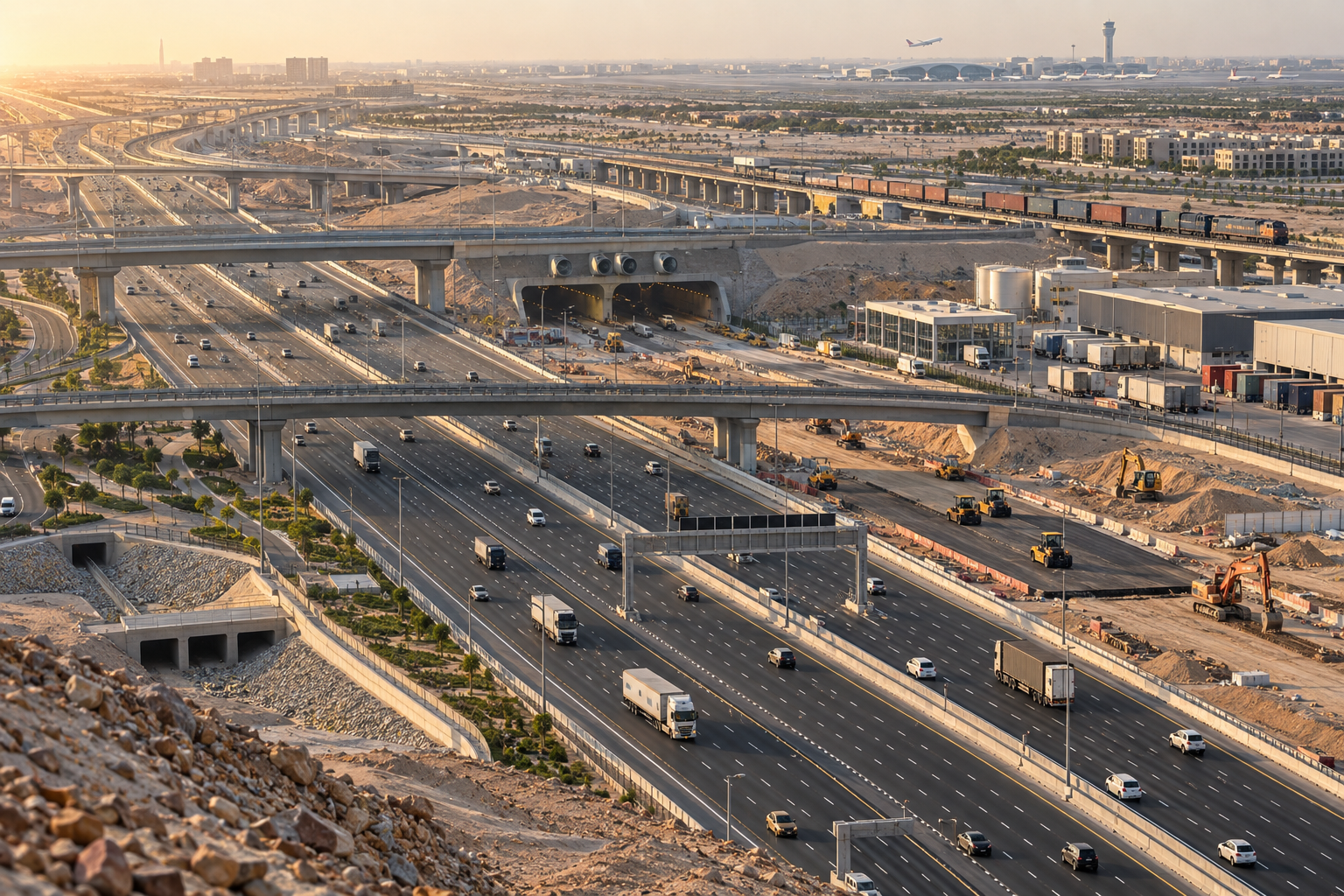
The new 80 km transport corridor will be able to handle up to 24,000 vehicles per hour, and the first phase of the project, costing 3.5 billion dirhams, will reduce travel time by up to 60%.
Dubai has approved the construction of a new 80 km, 12-lane highway, which will improve transport links between the emirate, Sharjah, and Abu Dhabi.
The project will be part of the UAE's large-scale road infrastructure development and will create an additional route bypassing the most congested transport corridors. The first phase of construction is estimated at 3.5 billion dirhams.
It is expected that once the project is completed, travel time on certain routes will be reduced by up to 60%, and the new road will serve more than 3.1 million people.
The first phase will connect Al Shanouf Road and Dubai-Al Ain Road
The highway will be built in stages.
The first section will run from Al Shanouf Road to Dubai-Al Ain Road. This is the part of the project for which the 3.5 billion dirhams is earmarked.
The second phase will extend the transport corridor from Dubai-Al Ain Road to Al Faya Road in Abu Dhabi.
The result will be a new inter-emirate route designed to redistribute some of the traffic between Dubai, Sharjah, and Abu Dhabi.
The new highway will feature 12 lanes
A key feature of the project will be its high capacity.
The motorway will include 12 lanes and will be able to handle up to 24,000 vehicles per hour in both directions.
The construction plan also includes:
- 72 bridges;
- 17 tunnels;
- 45 culverts for stormwater drainage.
The scale of the engineering infrastructure makes this project one of the most significant new road corridors in the country.
The new motorway will serve as an alternative to Dubai's congested roads
One of the project's primary goals is to reduce the burden on the existing road network.
The new route is intended to provide an additional option for motorists who currently use:
- Sheikh Zayed Road;
- Al Ittihad Road;
- Sheikh Mohammed bin Zayed Road;
- Emirates Road.
These highways play a key role in daily commutes between Dubai, Sharjah, Abu Dhabi, and the Northern Emirates, but population growth and the rising number of vehicles are gradually increasing the strain on existing infrastructure.
Creating another major transport corridor will help distribute traffic flow across multiple routes.
The highway will be connected to Al Maktoum International Airport and Etihad Rail
Integrating the new road with other types of transport infrastructure is of particular importance.
The motorway will connect to Al Maktoum International Airport and the Etihad Railnetwork.
Thus, the project will serve not only as an inter-emirate highway but will also become part of a broader transport network, linking road, air, and rail travel.
This integration is especially vital for passenger transport, logistics, and commercial vehicles.
Which areas will benefit from improved transport accessibility
The new infrastructure is set to improve road connectivity for several existing and developing areas.
These include:
- Madinat Latifa;
- Madinat Hind;
- Al Yalayis;
- Al Awir;
- Dubailand.
For these areas, the new transport corridor could create additional routes toward other parts of Dubai and neighboring emirates.
This is particularly important for developing areas, where the growth of residential and commercial construction is gradually increasing the number of daily trips.
The new road will support logistics between the emirates
The project is significant not only for Dubai residents.
Sheikh Mohammed bin Zayed Road currently provides transport links from Abu Dhabi to Ras Al Khaimah and connects a number of important districts and infrastructure facilities, including Expo City Dubai and Al Maktoum International Airport.
Emirates Road allows travel between the Northern Emirates and Abu Dhabi, bypassing the central districts of Dubai.
However, traffic intensity on these routes has increased significantly in recent years.
The new highway is intended to create an additional alternative and improve connectivity between residential areas, industrial zones, commercial centers, airports, and other transport hubs.
Infrastructure is viewed as a driver of economic development
Announcing the project, Sheikh Hamdan bin Mohammed emphasized the importance of infrastructure investment for the continued development of Dubai.
Expanding the road network is seen not only as a way to reduce congestion but also as a tool to support economic growth and improve the quality of life.
For a rapidly growing city, transport accessibility directly impacts workforce mobility, business operations, logistics, and the ability to develop new areas beyond already established central districts.
UAE to invest 170 billion dirhams in road network development
The new 80-kilometer highway is being implemented against the backdrop of a larger modernization of the country's transport infrastructure.
In November 2025, the UAE announced plans to invest 170 billion dirhams ($46 billion) into the development of the existing road network as part of a five-year program.
One of the projects will be the expansion of Al Ittihad Road, which is a vital transport route between Dubai and Sharjah. The plan is to add six lanes—three in each direction.
The modernization will also affect two other major highways.
Emirates Road is planned to be expanded to 10 lanes. This is expected to increase the road's capacity by 65% and reduce average travel time by 45%.
Sheikh Mohammed bin Zayed Road is also set to be expanded to 10 lanes, which will increase its capacity by approximately 45%.
What the new highway means for Dubai's real estate market
Major transport projects are of particular importance for the city's developing areas.
Improved road accessibility reduces travel time between residential communities, business districts, airports, and other parts of the emirate. As a result, locations previously perceived as remote can become more convenient for permanent residency.
In this case, special attention should be paid to Dubailand, Al Yalayis, Al Awir, Madinat Hind, and Madinat Latifa, as the project directly provides for the improvement of transport infrastructure in these areas.
For property buyers, this may mean a wider choice of areas to live in, especially if daily commutes to other parts of Dubai become faster.
For investors, transport accessibility is one of the factors that must be considered when assessing long-term rental demand and property liquidity.
At the same time, the construction of a new highway does not in itself guarantee an increase in property values. The investment potential of each project must be assessed taking into account the area's master plan, the volume of future supply, social infrastructure, construction quality, and actual demand.
The connection to Al Maktoum International Airport could become a key factor in the development of new districts
The integration of the highway with Al Maktoum International Airportdeserves special attention.
Developing the road network around a major transport hub improves airport access from various parts of the city and creates more convenient connections with neighboring emirates.
At the same time, the connection to Etihad Rail forms a more integrated transport system, where road, rail, and air routes complement one another.
In the long term, such infrastructure creates the conditions for the further development of residential, commercial, and logistics areas along new transport corridors.
Dubai continues its large-scale expansion of transport infrastructure
The construction of an 80-kilometer, 12-lane highway will be part of a broader program to develop the transport system of Dubai and the UAE.
The 3.5 billion dirham project is intended in its first phase to create a new route between Sharjah, Dubai, and Abu Dhabi, reduce congestion on existing highways, and improve accessibility to several developing districts.
For the real estate market, the significance of such projects becomes apparent gradually. New roads change the accessibility of districts, reduce daily commute times, and allow the city to expand more actively beyond traditional central locations.
As Dubai's population grows, investments in roads, the metro, rail infrastructure, and airports remain a key element in the continued development of the urban environment.


.avif)