
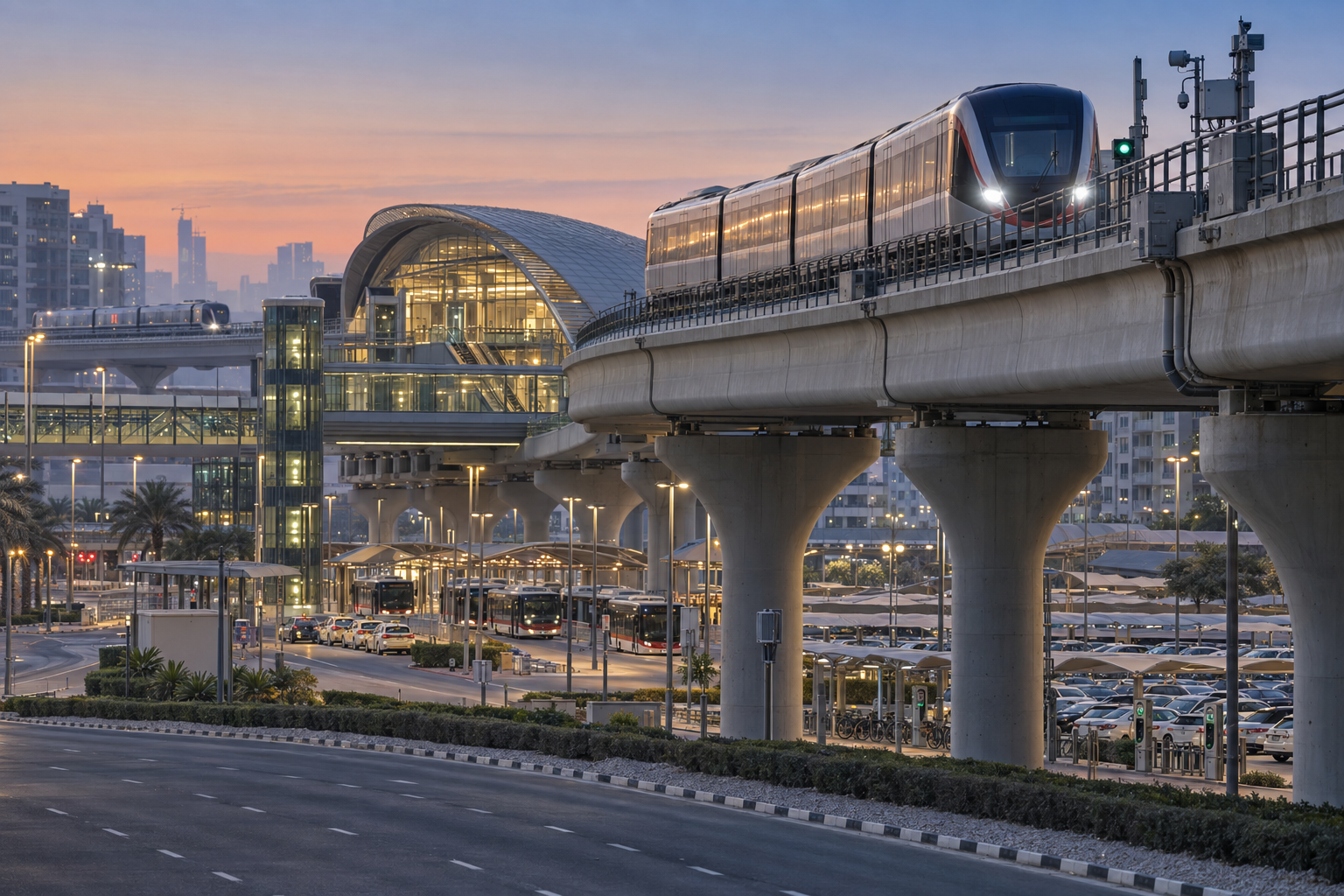
Over the past 17 years, the Dubai Metro has transported more than 2.4 billion passengers, becoming the backbone of the city's public transport system.
September 9, 2026, marked the 17th anniversary of the Dubai Metro. The first metro line was officially launched on September 9, 2009, at the symbolic time of 9:09:09 PM.
Over the years, the metro has evolved from an ambitious transport project into a cornerstone of Dubai's urban infrastructure. Today, it seamlessly connects residential areas, business districts, tourist attractions, and major transport hubs every day.
In 2025 alone, the Red and Green lines served 294.7 million passengers, an increase of 7% compared to the previous year.
The history of the Dubai Metro includes several phases of large-scale expansion, technological milestones, and infrastructure projects that continue to shape the city's development and improve accessibility across its districts.
The first trip took place in 2009
The first passenger of the Dubai Metro was His Highness Sheikh Mohammed bin Rashid Al Maktoum, Vice President and Prime Minister of the UAE and Ruler of Dubai.
He traveled from Mall of the Emirates station to Etisalat station in Al Qusais, which is now known as Etisalat by e& Metro Station.
Interest in this new mode of transport was high from the very first days. Within 48 hours of its launch, the metro was used by more than 110,000 people.
For a city where private cars had long been the primary means of travel, this result demonstrated a strong demand for modern public transport.
One of the largest automated metro systems
Since its launch, the Dubai Metro has become one of the most prominent driverless rail systems in the world.
Until 2016, it held the Guinness World Record for the longest fully automated, driverless metro network. At that time, its length was approximately 75 km.
Today, the Red and Green lines cover nearly 90 km and 55 stations.
The Dubai Metro was also the first urban rail system of its scale in the Gulf Cooperation Council countries.
Further expansion will continue with the introduction of new lines and stations.
Over 2.4 billion passengers since opening
In its 17 years of operation, the Dubai Metro has transported more than 2.4 billion passengers.
Trains have completed over 4.3 million trips, and the punctuality rate has reached 99.7%.
These figures reflect not only the scale of the system but also its role in the city's daily life.
In the first half of 2026, the metro served 136.5 million passengers, accounting for nearly 40% of all public transport trips in Dubai.
In total, the emirate's integrated transport network recorded 348.1 million passenger trips.
The metro has become a key part of urban mobility
Today, the Dubai Metro is used not only by tourists but also by hundreds of thousands of residents who commute daily for work, study, and other purposes.
Stations are integrated with bus routes, taxis, and other modes of transport, allowing the metro to function as part of a unified transport system.
For the real estate market, transport accessibility remains one of the factors that buyers and tenants consider when choosing an area.
Proximity to a metro station can increase living convenience and expand the potential pool of tenants, especially in areas with high business and tourist activity.
Station architecture reflects the history of Dubai
The design of the Dubai Metro combines modern architecture with elements of the emirate's cultural heritage.
The station interiors are based on the four natural elements:
- air;
- earth;
- fire;
- water.
The roof shapes of some stations resemble seashells, referencing the traditional pearl diving that historically played an important role in the region's economy.
One of the most recognizable examples is the BurJuman station, featuring large light installations reminiscent of jellyfish, with interior elements inspired by the history of pearl divers.
Route 2020 expanded the Red Line
One of the most significant stages in the metro's development was the construction of Route 2020.
The Red Line extension was implemented to improve transport accessibility for the Expo 2020 site and neighboring residential areas.
The new section expanded the network by approximately 15 km and included seven stations.
These include:
- Discovery Gardens;
- Al Furjan;
- Jumeirah Golf Estates;
- Dubai Investment Park;
- Expo 2020.
To service the new route, 50 Alstom trainswere purchased.
The capacity of the new trains has increased from 643 to 696 passengers. The trains feature upgraded lighting systems, digital information screens, and a more efficient interior layout.
The Green Line connected the city's historic districts
Green Line opened in 2011 and has become a vital part of the transport network in Old Dubai.
It provides access to historical and commercial districts, including areas near:
- Dubai Museum;
- Gold Souq;
- Spice Souq.
The architecture of several Green Line stations incorporates elements of traditional Emirati design.
In this way, the metro connects Dubai's modern business hubs with the areas where the city's historical center was formed.
The Blue Line will mark the next phase of expansion
One of the largest projects for the network's development is the Dubai Metro Blue Line.
In June 2025, Sheikh Mohammed laid the foundation stone for the new line, which is valued at 56 billion dirhams.
The Blue Line will span approximately 30 km, and the network will include 14 new stations.
The project includes the construction of the first-ever Dubai Metro railway bridge across Dubai Creek, spanning approximately 1.3 km.
Major interchange hubs and a new station are also planned, including Emaar Properties Station, which will stand about 74 meters tall.
Upon completion, the total length of Dubai's rail system, including the tram, is expected to increase to 131 km.
The Gold Line will add another 42 km of metro
The next major infrastructure project will be the Dubai Metro Gold Line.
According to the presented plans, the route will span approximately 42 km, and the line will include 18 stations.
The project is estimated to cost 34 billion dirhams.
The opening is scheduled for September 9, 2032.
The line is expected to run from Al Ghubaiba in Bur Dubai to Jumeirah Golf Estates and will be integrated with the existing Red and Green lines, as well as Etihad Rail.
Thanks to the new route, the metro will be able to directly serve areas such as:
- City Walk;
- Meydan;
- Global Village.
Busiest Dubai Metro stations
Population growth and the development of new districts continue to increase metro ridership.
In 2026, the busiest station in the network was BurJuman, which served approximately 8.4 million passengers.
Union followed with 6.5 million.
Other highly frequented stations on the Red Line included:
- Al Rigga — 6.4 million passengers;
- Mall of the Emirates — 5.2 million;
- Business Bay — 5 million.
On the Green Line, significant passenger traffic was recorded at the following stations:
- Sharaf DG — 4.9 million;
- Baniyas Square — 3.8 million;
- Stadium — 3.7 million.
The high volume of traffic at these stations reflects the concentration of residential, commercial, and tourist activity around key transport hubs.
The metro is adapted for People of Determination
All Dubai Metro stations are equipped with infrastructure for People of Determination.
This includes:
- elevators;
- tactile paving;
- dedicated spaces for wheelchairs on trains.
With a personalized nol card, People of Determination can use the metro for free.
This infrastructure is part of Dubai's overall strategy to create an accessible urban environment.
Train operations are managed by a centralized hub
Automatic train movement is controlled from the Operations Control Centre (OCC) in Rashidiya.
A backup control center is located in the Jebel Ali area.
Safety and infrastructure conditions are monitored by more than 3,000 camerascovering trains, stations, and tunnels.
The center monitors train movement and the status of technical systems, providing real-time operational updates.
The network is supported by approximately 1,800 specialists responsible for operations, maintenance, and safety.
Metro stations have become commercial and cultural hubs
The Dubai Metro is gradually evolving beyond its primary role as a transport system.
Since 2009, the city has operated a naming rightsprogram, allowing companies to purchase the commercial naming rights for individual stations.
This model provides an additional revenue stream for the transport system while establishing a framework for public-private partnerships.
Some stations are also used for cultural projects.
During the Dubai Metro Music Festival , musicians perform at Union, BurJuman, The Dubai Mall, Mall of the Emirates, and DMCC stations.
Over the years, the metro has also served as a venue for other city events, including fashion shows.
Additional services make travel more convenient
The Dubai Metro infrastructure includes a range of passenger services.
Free Wi-Fi is available on trains and at stations.
Park-and-Ride parking facilities with a total capacity of over 8,000 vehicles are located near the Centrepoint, Jabal Ali, and Etisalat stations.
Most stations are integrated with the bus network and taxi drop-off zones.
The stations also feature shops, cafes, and other commercial facilities.
BurJuman station features a coworking space WO-RK, allowing passengers to use the station not just as a transport hub, but also as a place to work.
Building a metro system requires complex engineering solutions
Specialized tunnel boring machines were used to construct the underground sections.
The construction of the initial lines utilized a machine named Al Wugeisha, which bored the tunnels between Union and BurJuman.
Significantly larger equipment is being used for the development of the Blue Line.
The new tunnel boring machine is approximately 163 meters long and weighs about 2,000 tons.
The increase in the scale and power of the equipment reflects the growing complexity of projects as the city continues to expand.
How the metro influences Dubai's real estate development
The expansion of rail infrastructure is also significant for the real estate market.
New stations improve transport accessibility in neighborhoods, reduce residents' reliance on private cars, and create additional connections to business hubs, airports, and key city landmarks.
For buyers and investors, this makes the location of a property relative to future and existing metro stations a key factor in project analysis.
However, proximity to the metro does not automatically guarantee an increase in property value. It is essential to consider the quality of the neighborhood, the developer's reputation, future supply volume, infrastructure, and actual demand from tenants and buyers.
Nevertheless, in the long term, the expansion of the metro contributes to more balanced urban development and improves connectivity between new districts and the center of Dubai.
The Dubai Metro remains a symbol of the emirate's development
Over 17 years, the metro has evolved from a novel transport experiment into an infrastructure system used by hundreds of millions of passengers annually.
Today, the Dubai Metro connects old and new districts, tourist destinations, business hubs, and major residential communities.
The ongoing construction of the Blue Line and plans for the Gold Line demonstrate that the role of rail transport in Dubai's infrastructure will only continue to grow.
For a city with a constantly growing population and economy, metro development is a key tool for enhancing mobility, improving the urban environment, and ensuring transport accessibility for new areas.


.avif)