
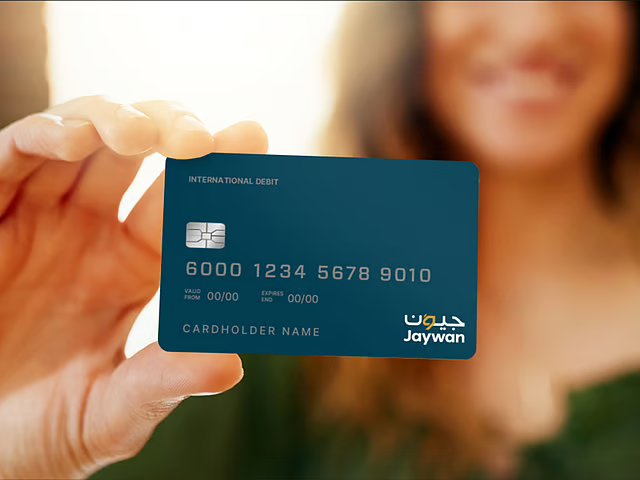
The UAE has launched its own payment card
The United Arab Emirates has begun the phased rollout of Jaywan, the country's first national card payment system. Banks, financial institutions, and licensed exchange houses have already started issuing and servicing the new cards.
Jaywan will serve as an additional payment method alongside international systems like Visa and Mastercard. Establishing a domestic payment infrastructure is intended to enhance the UAE's financial independence, reduce the costs of processing domestic transactions, and ensure that transaction data is stored within the country.
With the launch of Jaywan, the Emirates joins the ranks of nations developing their own national payment networks. Similar systems are already in operation in China, India, Saudi Arabia, and Brazil.
What is the Jaywan payment system?
Jaywan is the UAE's national card system, developed by Al Etihad Payments. This organization is a subsidiary of the Central Bank of the UAE and is responsible for developing the country's modern payment infrastructure.
In the initial phase, financial institutions are issuing Jaywan debit and prepaid cards. Plans are in place to expand the product line to include credit cards in the future.
Before the introduction of the new system, a significant portion of domestic card transactions was processed through international payment networks. Jaywan provides a local alternative, allowing domestic payments to be processed via national infrastructure.
Why did the UAE launch a national payment system?
The development of Jaywan addresses several strategic objectives simultaneously.
The new system allows for:
- reducing reliance on foreign payment operators;
- processing domestic transactions through UAE infrastructure;
- storing payment data within the country;
- lowering costs for banks and merchants;
- increasing the speed and security of transactions.
In this way, Jaywan becomes part of the UAE's broader policy to strengthen its digital economy and develop an independent financial infrastructure.
Which banks are already working with Jaywan?
Card issuance has already begun, though the onboarding of financial institutions is taking place in stages.
Eleven banks and financial companies are ready to work with the system. Among them are:
- First Abu Dhabi Bank;
- Abu Dhabi Commercial Bank;
- Emirates Islamic;
- Commercial Bank of Dubai;
- Citi;
- Mbank;
- Botim.
As the project develops, additional banks, exchange houses, and fintech services are expected to join Jaywan.
Network International has also enabled online payment acceptance for Jaywan cards at thousands of merchants across the UAE.
Key benefits of Jaywan cards
The national payment system offers advantages for individual users, as well as the banking and retail sectors.
Lower banking costs
Utilizing local infrastructure can help reduce card issuance and maintenance expenses over time.
For customers, this may lead to a wider range of affordable debit products. Merchants may also benefit from lower payment processing fees.
Reduced transaction costs
When using international payment networks, a portion of the costs is associated with cross-border transaction processing.
Jaywan enables domestic payments to be processed through national infrastructure, which can lower costs for banks, financial institutions, buyers, and sellers.
Data residency
Payment information will be processed and stored within the UAE.
This approach enhances control over financial infrastructure and reduces the need to transmit data to overseas servers.
Fast payment processing
Domestic transactions will be processed through the UAESWITCH system.
Using a local payment network is expected to increase the efficiency and speed of transaction processing within the country.
What security technologies does Jaywan use
Jaywan cards support modern payment security standards.
The system integrates:
- EMV chips;
- 3D Secure technology;
- contactless payment;
- PIN-based transaction verification.
These technologies are used to protect cardholder data and reduce the risk of unauthorized transactions.
What Jaywan cards are available to users
At this stage, several card categories are available:
- Jaywan Prestige Debit Card;
- Jaywan Royal Debit Card;
- Jaywan Prepaid Card.
Prestige and Royal debit cards are designed for users who value additional privileges and services.
The prepaid card is better suited for tracking daily expenses and budget planning. Users can top up their account with the required amount in advance and manage their spending without using credit funds.
Jaywan credit cards are expected to be launched in the future.
What privileges do premium cards offer
The set of benefits depends on the card category and the specific terms of the issuing bank.
Premium cardholders may have access to:
- airport lounge access via Priority Pass;
- travel insurance;
- purchase protection;
- a Jaywan Entertainer subscription;
- special Careem+ terms;
- Reel Cinemas offers;
- airline bonuses;
- discounts at over 150 partners nationwide.
Privileges may also extend to hotels, restaurants, shops, car rentals, supermarkets, and tourist attractions.
We recommend checking the current list of offers with your bank or on the official Al Etihad Payments website.
Where you can use your Jaywan card
National payment system cards are designed for everyday use.
You can use them to:
- pay for purchases in stores;
- make online payments;
- withdraw cash from ATMs;
- use the card in compatible digital wallets.
Support for Apple Pay, Google Pay, and Samsung Pay is planned for a later date.
Will Jaywan work outside the UAE?
International card usage will be expanded gradually.
In the future, Jaywan will be able to operate in more than 100 countries. The ability to make payments and withdraw cash abroad will depend on the card type, the partner payment network, and the terms set by the issuing bank.
Before traveling, cardholders are advised to check in advance whether their card supports international transactions and what fees apply outside the UAE.
How did India participate in the creation of Jaywan?
NPCI International Payments Limited participated in the development of the national system.
Al Etihad Payments and NIPL signed a cooperation agreement in October 2023. The Indian organization is the international arm of NPCI, which previously created the RuPay payment system.
The development of Jaywan leveraged India's experience in building a domestic card network capable of complementing international payment systems and processing a significant portion of domestic transactions.
How to get a Jaywan card
To apply for a card, you need to contact a bank or financial institution that is connected to the system.
Before submitting an application, it is recommended to check:
- whether Jaywan issuance is available;
- what types of cards the bank offers;
- the amount of the service fee;
- the terms for international transactions;
- current discounts and bonus programs;
- requirements for opening an account.
As the rollout is taking place gradually, terms and card availability may vary depending on the chosen financial institution.
What does the launch of Jaywan mean for the UAE economy?
The creation of a national payment system strengthens the country's financial independence and supports the development of the digital economy.
Local payment processing can reduce operating costs, increase the transparency of financial infrastructure, and create new opportunities for banks, fintech companies, and retail businesses.
For foreign investors, the development of such systems is a sign of a mature financial market. Modern banking infrastructure simplifies doing business, processing customer payments, and managing capital within the country.
How the development of payment infrastructure is linked to the real estate market
Real estate transactions, bank account management, utility payments, and the daily expenses of residents depend directly on the quality of financial infrastructure.
The development of a national payment system can improve the convenience of domestic transactions for property owners, tenants, entrepreneurs, and foreign professionals moving to the UAE.
While the launch of Jaywan does not have a direct impact on residential property prices, it is part of the country's overall financial modernization. Robust banking and payment infrastructure supports business activity, attracts international capital, and enhances the quality of life for long-term residents in the Emirates.
The UAE continues to develop an independent financial ecosystem
The launch of Jaywan marks a significant milestone in the development of the UAE's domestic payment infrastructure.
As more banks join and the system's capabilities expand, residents will gain access to additional card products, digital services, and loyalty programs.
The national payment network complements existing international solutions and strengthens the UAE's position as a modern financial hub focused on technology, security, and long-term economic development.


.avif)