
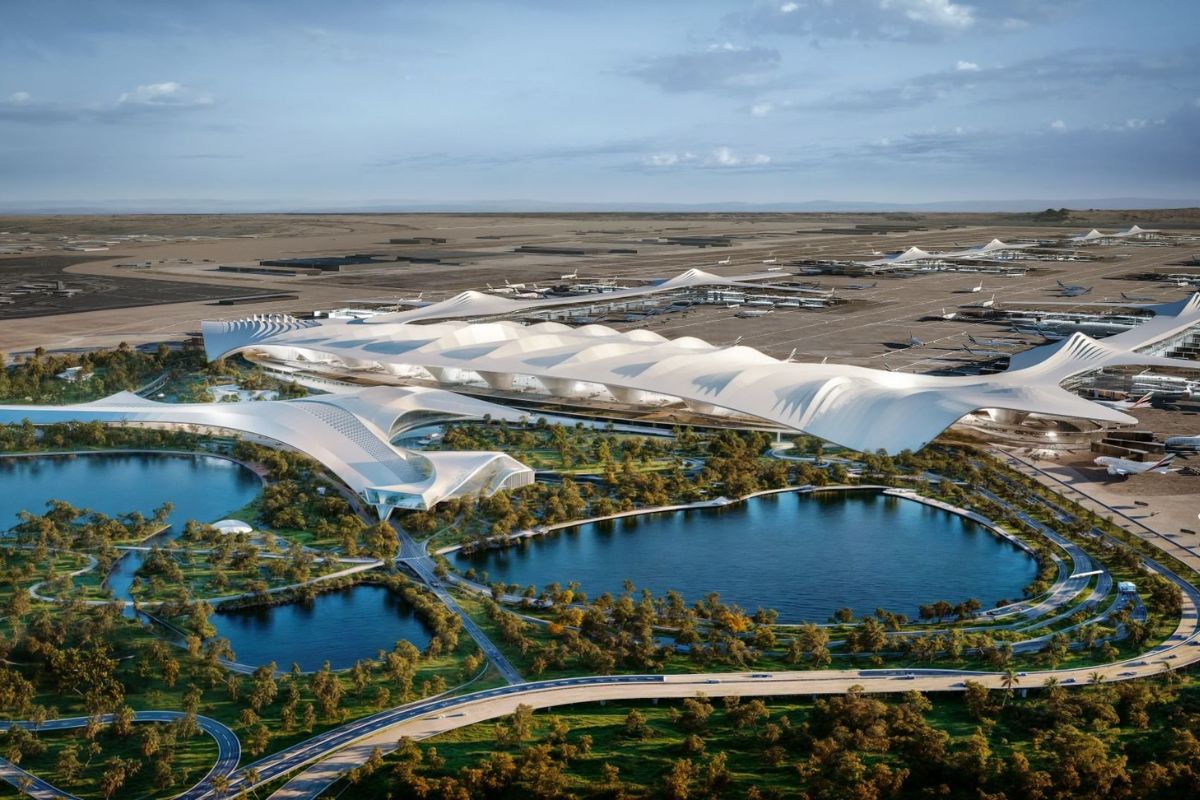
The AED 128 billion project is reshaping the emirate's investment landscape
The massive AED 128 billion (approximately USD 34.9 billion) expansion of Al Maktoum International Airport is driving a surge in investor interest in the southern part of Dubai.
The project is having the most significant impact on the Dubai South, Emaar South, Expo City Dubai, and Jebel Ali areas. These locations are seeing simultaneous development of transport infrastructure, business clusters, logistics facilities, and new residential communities.
For the real estate market, the significance lies not just in the construction of the airport itself, but in the economic activity that will form around it. Job creation, the opening of new businesses, and population growth are set to drive demand for housing, offices, hotels, and retail space.
Al Maktoum International Airport is set to become one of the world's largest airports
Once all expansion phases are complete, the airport will be able to handle up to 260 million passengers annually. The cargo infrastructure is designed to have a capacity of approximately 12 million tons per year.
The aviation complex will include:
- five parallel runways;
- over 400 aircraft stands;
- world-class passenger and logistics infrastructure.
In the first phase, the airport's capacity is expected to reach approximately 150 million passengers per year.
This scale makes the project one of the largest infrastructure undertakings in Dubai's history and establishes the foundation for the continued development of the emirate's southern transport and economic corridor.
A new economic cluster is taking shape around the airport
Project estimates suggest that the airport expansion could contribute approximately AED 6.1 billion to Dubai's GDP by 2030.
It is also expected to create approximately 132,000 jobs.
This employment growth is likely to boost demand across several real estate segments:
- residential apartments;
- villas and townhouses;
- office space;
- hospitality properties;
- retail facilities;
- social and community infrastructure.
This means the airport's impact will extend far beyond the aviation industry. The project is set to become the foundation for a new business and residential hub, concentrating logistics, trade, tourism, passenger services, and corporate operations.
Dubai South is showing growth in business activity
Dubai South is already developing into one of the key business districts in the southern part of the emirate.
During 2025, 653 new companies were registered in the district, bringing the total number of active enterprises to over 4,200.
The number of new business licenses increased by 65%, and the retention rate for existing companies reached 90%.
These figures point to the formation of a sustainable business environment. The district's additional advantages include its proximity to Al Maktoum Airport, logistics zones, free economic zones, and the port of Jebel Ali.
As a result, Dubai South is gradually evolving into a multifunctional district that integrates workspaces, residential properties, transport infrastructure, and everyday amenities.
Residential sales in Dubai South continue to rise
Interest in residential real estate in Dubai South is intensifying against the backdrop of the district's development and the construction of new infrastructure.
In 2024, the total volume of residential sales in Dubai South exceeded 19 billion dirhams, equivalent to approximately 5.17 billion US dollars.
High demand is also confirmed by individual project launches. The first tower of the South Square residential complex was completely sold out within three hours of the launch.
This momentum shows that buyers are evaluating the district not only by its current state but also by its prospects for further development over the next five to ten years.
Emaar South is developing as a residential community near the airport
Emaar South remains one of the most prominent residential projects in southern Dubai.
The district features:
- apartments;
- townhouses;
- villas;
- properties located next to an 18-hole golf course.
The development of the airport and transport infrastructure may increase the appeal of Emaar South for professionals, entrepreneurs, and families working in the southern part of the city.
For investors, the district is attractive due to the combination of a major developer, new residential projects, and proximity to an emerging business cluster.
Expo City Dubai is transforming into a full-fledged multifunctional district
Expo City Dubai continues to evolve following the conclusion of Expo 2020, gradually establishing itself as an independent urban hub.
It is developing into an environment that integrates:
- residential projects;
- office spaces;
- exhibition infrastructure;
- commercial facilities;
- public spaces;
- transport links.
Proximity to Dubai South and Al Maktoum International Airport reinforces the role of Expo City Dubai in the development of the southern corridor.
The district is an attractive option for both homebuyers looking for a place to live and investors focused on long-term rental yields and capital appreciation.
Jebel Ali strengthens the logistical significance of the southern corridor
An additional factor driving the development of southern Dubai is the Jebel Ali port — one of the region's largest logistics hubs.
In the first half of 2025, 545,000 vehicles passed through the port, a 28% increase compared to the same period last year.
The connection between the port, the airport, free economic zones, and residential areas creates a major transport and business corridor.
For the real estate market, this generates demand from employees of logistics companies, international corporations, the aviation sector, and businesses operating in trade and transport.
International investors are exploring southern Dubai
Foreign buyers continue to view the Dubai real estate market as a tool for capital preservation, rental income, and international asset diversification.
In the second quarter of 2025, investment volume from UK buyers increased by 62% compared to the same period last year. As a result, British citizens have become one of the largest groups of foreign real estate buyers in Dubai.
Investors from India also maintain a high level of interest in the emirate's market, looking at properties for rental income, business operations, relocation, and long-term family living.
Southern districts are attracting international buyers with a combination of earlier-stage development, major infrastructure projects, and prospects for population growth.
Proximity to the airport is not the only selection criterion
A location near a major airport does not, in itself, guarantee the investment appeal of a specific property.
Before purchasing real estate, it is important for an investor to evaluate:
- the developer's reputation and track record;
- construction completion timelines;
- project quality;
- the volume of future supply in the area;
- property type;
- transport accessibility;
- the availability of schools, shops, and public infrastructure;
- potential demand from tenants.
It is also necessary to consider that the development of Southern Dubai is planned for the long term. Therefore, such investments are generally better suited for buyers with a multi-year horizon rather than those looking solely for rapid capital appreciation.
Which real estate segments may see increased demand
The creation of a new economic hub is likely to support various categories of properties.
The most sought-after options may include:
Affordable apartments for employees
The growth in the number of jobs will increase the need for studios and one- or two-bedroom apartments located near transport infrastructure.
Family townhouses and villas
Professionals and executives relocating to the southern part of Dubai are likely to drive demand for spacious housing in communities featuring schools, parks, and everyday amenities.
Office real estate
The launch of new companies and the expansion of the logistics sector are set to boost demand for office space.
Hotels and serviced apartments
Rising passenger traffic and business activity are expected to support the hospitality sector and the short-term rental market.
Retail space
Population growth will create a need for shops, restaurants, medical centers, and other commercial facilities.
What the airport expansion means for investors
Al Maktoum International Airport is becoming a key driver of long-term development in Dubai South.
For investors, the primary significance lies not only in future passenger volumes but also in the associated processes:
- job creation;
- an increase in the number of companies;
- transport network development;
- population growth;
- construction of residential and commercial real estate;
- development of social infrastructure.
The greatest potential lies in projects that combine a prime location, a reliable developer, realistic construction timelines, and a clear target audience of tenants or buyers.
Dubai South is emerging as a new hub for real estate market growth
The expansion of Al Maktoum Airport is gradually reshaping the emirate's development landscape.
Dubai South, Emaar South, Expo City Dubai and Jebel Ali are coming together to form a major economic and residential hub focused on aviation, logistics, international trade, and business.
Over the next decade, the southern part of Dubai is poised to become a primary driver for population growth, employment, and real estate demand.
This presents new opportunities for buyers and investors, though selecting a property requires a comprehensive analysis of the area, the project, the developer, and the potential demand upon completion.


.avif)